Facing a VMware renewal in 2026? You’re not alone. Broadcom’s licensing changes have doubled costs for many IT teams, which include per-core subscriptions, forced bundles, and audit headaches.
The upside? You’ve got options. Gartner and G2 rank several strong VMware alternatives that cut complexity and costs. This guide lists the top five VMware competitors based on analyst reports and real-world feedback.
Leading the pack is Sangfor HCI, a VMware alternative that doesn’t just match features; it delivers integrated security, flexible pricing, and smooth migration. Ready to rethink your virtualization strategy? Dive into the best options we’ve listed here for high availability without the chaos.
VMware Alternatives that both Gartner & G2 Recommend
The following are some alternatives to VMware that appear in the recommendations by both Gartner and G2:
1. Sangfor HCI – G2 Leader, Gartner HCI Sample Vendor
Sangfor HCI tops our list because it nails what IT leaders and enterprise decision makers crave: full HCI without VMware’s pricing pain. G2 users rave about its 4.9/5 ease of use, praising agentless VMware migrations and built-in everything.
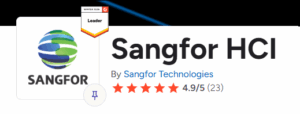
On top of that, Gartner calls it a “sample vendor” for hyperconverged infrastructure VMware alternatives, highlighting distributed retail/edge deployments.
Key Wins:
- Socket-based perpetual licensing: Sangfor HCI solves VMware licensing issues by offering flexible, cost-effective pricing. No 72-core traps.
- Integrated security stack: Worried about security? That’s where Sangfor got you as well. You can leverage their full suite of security stack, including Athena Next-Generation Firewall (NGFW), Athena Endpoint Protection Platform (EPP), Athena Network Detection & Response (NDR), and Athena Secure Access Service Edge (SASE).
- All-in-one HCI: aSV hypervisor (Enterprise Plus parity), aSAN auto-tiering, Backup Platform Powered by Veeam, 3-node DR.
G2 Score: 4.9/5 | Gartner: HCI Representative Vendor.
Client PoV: Sangfor HCI holds a stellar 4.7 out of 5 rating across 138 reviews, with a full 100% willingness to recommend. Plus, many users reported having their TCO getting reduced by up to 70% compared to traditional 3-tier data centers.
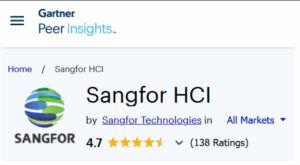
Sangfor HCI’s Score on Gartner Peer Insight
2. Nutanix AHV – Gartner Visionary, G2 Enterprise Favorite
Nutanix AHV ranks high for HCI polish. Gartner’s Magic Quadrant names it a Visionary for distributed hybrid infrastructure, praising Prism’s single-pane magic. G2 gives it 4.5/5 for scalability, though some gripe about software fees stacking up.
Key Wins:
- Acropolis hypervisor with Flow micro-segmentation
- One-click updates, self-healing clusters
- Strong hybrid cloud bursting
Client PoV: Mid-market teams love it for VMware swaps, but watch subscription costs (~$10K/node/year). Great if you’re already Nutanix-invested.
G2 Score: 4.5/5 | Gartner: Visionary in HCI MQ
3. Microsoft Hyper-V – G2 Windows King, Gartner Enterprise Staple
Hyper-V dominates Windows shops. G2 users score it 4.6/5 for cost-effectiveness, bundled in Server Datacenter, no VMware-style core explosion. Gartner flags it as the top VMware alternative for Microsoft ecosystems.
Key Wins:
- Shielded VMs, Live Migration, Azure Arc management
- Perpetual socket licensing (~$6K/socket)
- Seamless Active Directory integration
Client PoV: Enterprises with Microsoft stacks save 50%+ TCO. My buddy at a bank flipped 200 VMs—done in weeks. Less ideal for Linux-heavy workloads.
G2 Score: 4.6/5 | Gartner: Best MS Alternative
4. Proxmox VE – G2 SMB Darling, Open-Source Gartner Nod
Proxmox VE wins for budget-conscious teams. G2’s 4.4/5 reflects SMB love for free KVM/LXC power. Gartner mentions it in “Which VMware Alternatives Are Enterprises Evaluating?” for cost-cutters.
Key Wins:
- Zero licensing, hardware only
- ZFS/Ceph storage, web GUI, HA clustering
- REST API for automation
Client PoV: Perfect starter platform. One small retailer consolidated 30 servers to 3 nodes, and the power bill dropped 60%. Scales decently, but enterprise support costs extra.
G2 Score: 4.4/5 | Gartner: SMB Representative
5. Red Hat OpenShift Virtualization – Gartner Container Leader, DevOps G2 Pick
Red Hat rounds out the top 5 for modern workloads. Gartner’s OpenShift praise spills into virtualization (KubeVirt). G2 scores 4.5/5 for hybrid VM/container runs.
Key Wins:
- VMs on Kubernetes, GitOps automation
- Multitenant, ~$0.06/vCPU/hour subs
- Strong RHEL ecosystem
Client PoV: DevOps teams thrive, but pure virtualization feels bolted-on. Legacy VM shops might struggle with the learning curve.
G2 Score: 4.5/5 | Gartner: Container MQ Leader
Cost & Control Comparison Table
| Rank | Alternative | G2 Score | Gartner Status | 3yr TCO (10-host equiv.) | Key Edge |
| 1 | Sangfor HCI | 4.9/5 | HCI Sample | $70K | Security+Licensing |
| 2 | Nutanix AHV | 4.5/5 | Visionary | $280K | HCI Polish |
| 3 | Hyper-V | 4.6/5 | Enterprise Alt | $90K | Windows Fit |
| 4 | Proxmox VE | 4.4/5 | SMB Rep | $220K | Free Power |
| 5 | Red Hat | 4.5/5 | Container Leader | Variable | DevOps |
Why Sangfor HCI Perfectly Replaces VMware
Sangfor HCI is built for 2026 realities. It matches VMware’s power without Broadcom’s licensing headaches. Most importantly, Sangfor comes with no per-core surprises, no forced bundles, just socket-based pricing that saves up to 40-70%.
One edition unlocks everything: enterprise-grade virtualization with the aSV hypervisor (vMotion, DRS, vGPU), smart storage via aSAN, and visualized networking without NSX complexity. Backup? Veeam-powered protection is included.
Security isn’t bolted on with Sangfor server virtualization. It’s native. The Athena suite delivers NGFW for perimeter defense, EPP for endpoints, NDR for lateral threats, SASE for zero-trust access, and XDR/MDR for advanced detection.
Sangfor is not just a platform; it’s also an MSSP and MDR service provider, giving you 24/7 threat monitoring. Real-world wins? Fast migrations, lower costs, and peace of mind. If you’re planning to move from VMware, Sangfor HCI is the smart choice.
Proven Migrations: Agentless aHM tool ports VMs weekend-style. Manufacturing firms report 150+ VMs transferred seamlessly.
G2 Loves It: 4.7/5 for “setup ease” and “VMware migration.” Users call it “vSphere without the bill shock.”
Gartner Recognition: Sample HCI vendor in “VMware Alternatives” report, strong for distributed/edge with resilience focus.
Real story: Regional bank tested Sangfor HCI during refresh. Found VMware’s $120K/year cluster cost. Sangfor 3-node setup? $50K perpetual. Added Athena MDR, threats blocked automatically. Now they’re scaling branches without worry.
Why does Ranking Matter for VMware Alternatives?
VMware’s dominance is fading. Its rigid licensing and complex bundles have left CIOs frustrated. Meanwhile, alternatives like Sangfor (according to Gartner and G2) are gaining momentum with flexible, cost-friendly, and security-focused platforms.
Analyst reports cut through the noise. User reviews show VMware struggles with satisfaction, while top alternatives earn stronger praise. Gartner backs their scalability claims, proving these platforms aren’t just hype; they’re real solutions.
Your 2026 Action Plan
Before you sign that renewal, pause. Audit your VMware core costs and compare them against alternatives. Start with a quick POC—Sangfor HCI plus one other fit, like Hyper‑V or Nutanix. Test migration using Sangfor’s free aHM tool; most teams prove it over a weekend. Then stack up the three‑year TCO. The numbers speak louder than promises.
Bottom line: Sangfor HCI delivers VMware‑level performance without the complexity or cost. Flexible pricing, built‑in security, and proven migrations make it the safe bet for 2026. Check out how they made things happen so far here!
Don’t renew blind. Grab the free POC and see why CIOs switching to Sangfor are finally sleeping better.