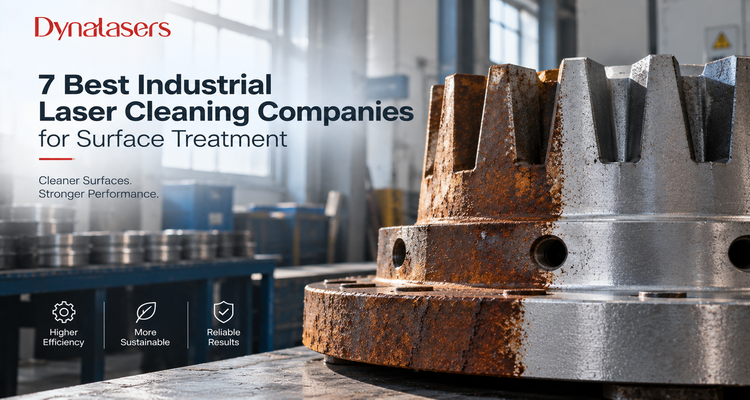
Industrial laser cleaning is no longer limited to small rust-removal demonstrations. It is increasingly used for coating removal, weld preparation, oxide cleaning, mold maintenance, and other jobs where blasting or chemical stripping creates extra handling.
When comparing industrial laser cleaning companies, I would focus on the actual surface condition first. Cleaning 20 m² of corroded steel is a very different job from removing residue from a precision mold. Dynalasers addresses both sides with high-power CW and controlled MOPA pulsed systems.
7 Industrial Laser Cleaning Companies Compared
|
Company |
Representative Technology |
Main Strength |
Typical Application |
|
M75 / P300 |
Compact CW and MOPA pulsed options |
Rust, coatings and precision cleaning |
|
|
Laserax |
Industrial laser cleaning systems |
Automation and production integration |
Production lines |
|
CleanLASER |
Pulsed laser cleaning |
Precision surface processing |
Industrial components |
|
P-Laser |
Pulsed cleaning systems |
Specialized cleaning technology |
Maintenance and surface treatment |
|
SENFENG |
CW / pulsed laser cleaners |
Broad equipment range |
General metal cleaning |
|
GWEIKE |
CW / pulsed systems |
Multiple configurations |
Workshop applications |
|
JPT |
MOPA fiber laser technology |
Pulse control |
Controlled surface processing |
The main difference between these companies is not simply laser power. Industrial cleaning usually comes down to two questions: how quickly does material need to be removed, and how much change to the substrate is acceptable?
That is also the easiest way to understand where Dynalasers laser cleaning equipments M75 and P300 fit.
Start With the Surface, Not the Wattage
One mistake I often see when comparing laser cleaners is starting with “How many watts do I need?”
The better starting point is what needs to come off. Thick corrosion, paint, light oxide, oil contamination, and mold residue absorb laser energy differently. The substrate underneath matters just as much.
For industrial work, I would define:
- substrate material;
- contamination or coating;
- approximate layer thickness;
- cleaning area per shift;
- required final surface;
- acceptable heat input;
- part geometry.
Once these are known, the choice between continuous-wave and pulsed cleaning becomes much easier.
Dynalasers M75 for Larger Industrial Cleaning Jobs
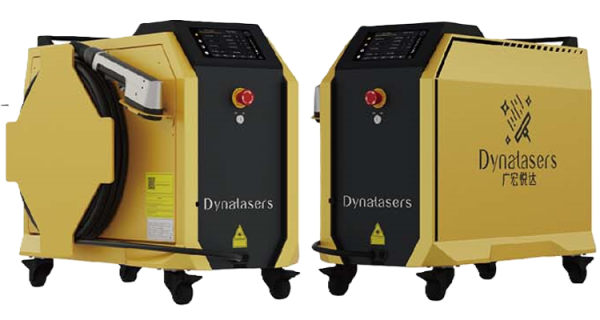
The Dynalasers M75 uses a CW laser with output up to 1800W. It is the more logical starting point when throughput matters and the substrate can tolerate the process heat.
Typical jobs include rusted steel structures, fabricated components, machinery, paint removal, and surface preparation before welding or recoating.
Where Higher CW Power Helps
Average power matters when there is a lot of material to remove.
If I were cleaning widespread corrosion from steel frames, I would normally favor the M75 over a 300W pulsed machine. The higher CW output provides more energy for covering larger areas, especially where preserving an extremely delicate surface is not the main requirement.
That does not mean running at maximum power all the time. Scan width, travel speed, overlap, and stand-off still need to be adjusted. Moving too slowly can put unnecessary heat into the part, while moving too quickly leaves contamination behind.
Good applications for the M75 include:
- heavy or widespread rust;
- paint and coating removal;
- steel fabrication maintenance;
- pre-weld oxide removal;
- preparation before repainting;
- large metal components.
For these jobs, cleaning rate is often more valuable than very fine pulse control.
Dynalasers P300 When Surface Control Matters
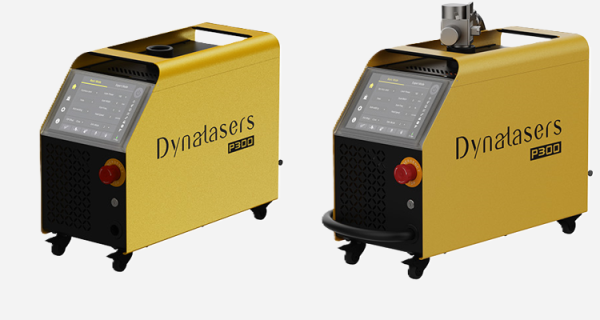
The P300 solves a different problem.
It uses a 300W MOPA pulsed fiber laser. Instead of delivering energy continuously, it delivers controlled pulses that can be adjusted through parameters such as pulse width and frequency.
Why Pulsed Cleaning Is Different
Pulsed cleaning is useful when I want more separation between removing the unwanted layer and affecting the material underneath.
That makes the P300 more suitable for molds, thinner components, localized oxide, precision parts, and surfaces where excessive heat or visible surface change would be undesirable.
A lower average wattage should therefore not automatically be interpreted as a weaker cleaner. An 1800W CW machine and a 300W MOPA machine are designed around different priorities.
For an industrial laser cleaning company, having access to both technologies is useful because forcing one laser type onto every cleaning job usually means accepting unnecessary compromises.
M75 or P300: Which One Fits the Job?
For most industrial users, the decision can be narrowed down fairly quickly.
|
Requirement |
M75 CW |
P300 MOPA Pulsed |
|
Heavy rust |
✓ |
|
|
Large-area cleaning |
✓ |
|
|
Paint removal |
✓ |
✓ |
|
High throughput |
✓ |
|
|
Thin or sensitive parts |
|
✓ |
|
Mold cleaning |
|
✓ |
|
Controlled oxide removal |
|
✓ |
|
Lower thermal impact |
|
✓ |
Actual results depend on the material, contamination, parameters, scan strategy, and required final surface.
I would still test the real part before making a final choice. Even two painted steel components can behave differently if the coating chemistry or thickness changes.
Cleaning Speed Numbers Need Context
Cleaning rate is one specification I would treat carefully when evaluating industrial laser cleaning companies.
A figure in square meters per hour means very little without knowing what was removed. Light surface oxidation can disappear in one fast pass. Thick paint or layered corrosion may need slower scanning or several passes.
Geometry changes the result too. A flat plate is easier to clean consistently than weld seams, corners, grooves, cast surfaces, or complex machinery.
If a supplier provides a cleaning-speed figure, ask for the conditions behind it:
Those six answers make the number much more useful.
Why Compact Equipment Matters on Industrial Sites
Surface cleaning often happens where the component already sits.
Large frames, machinery, welded structures, molds, and installed components may be inconvenient to move to a dedicated cleaning station. In those situations, portability affects the whole workflow rather than just transport.
This is one reason Dynalasers develops compact air-cooled systems. Eliminating a conventional water-cooling circuit reduces the amount of equipment that has to move with the cleaning job.
The cleaning head matters as well. If an operator is working around a large frame for several hours, cable management, reach, gun weight, and access to corners can influence productivity just as much as the laser specification.
What I Would Test Before Buying
A good demonstration should use the customer’s surface, not a supplier’s ideal sample.
Send an actual rusty, painted, oxidized, or contaminated component when possible. Define what the finished surface should look like and ask the supplier to record the settings used.
I would check:
- whether contamination is completely removed;
- whether the substrate changes color;
- surface texture after cleaning;
- heat accumulation;
- number of passes;
- realistic working speed;
- performance around edges and recesses.
Fume extraction also needs to be considered. Laser cleaning does not make the removed material disappear. Rust, paint, oxide, and contamination become particles and fumes that need appropriate capture and filtration.
This is particularly important with old coatings whose composition may not be known.
FAQs
Can laser cleaning prepare metal for welding?
Yes. It can remove rust, oxide, oil, and some coatings from the joint area. The required cleanliness should still be established around the welding process and material.
Can laser cleaning change surface roughness?
It can. The effect depends on laser type, energy density, pulse characteristics, number of passes, and substrate. Test the process when surface texture is a controlled requirement.
Does laser cleaning work on curved parts?
Yes, but maintaining suitable focus and scan coverage becomes more difficult as geometry changes. Deep recesses and obstructed surfaces may require different working angles or multiple passes.
Is laser cleaning completely maintenance-free?
No. It avoids abrasive media and many chemical consumables, but optics, protective lenses, extraction filters, and other components still require inspection and maintenance.
Conclusion
The best industrial laser cleaning companies should be able to match the process to the surface rather than recommend one machine for every job.
Dynalasers covers two distinct industrial needs with the M75 and P300. The M75 favors higher-throughput CW cleaning, while the P300 provides MOPA pulsed control for more sensitive surfaces. In either case, testing the actual part remains the most reliable way to choose the right process.