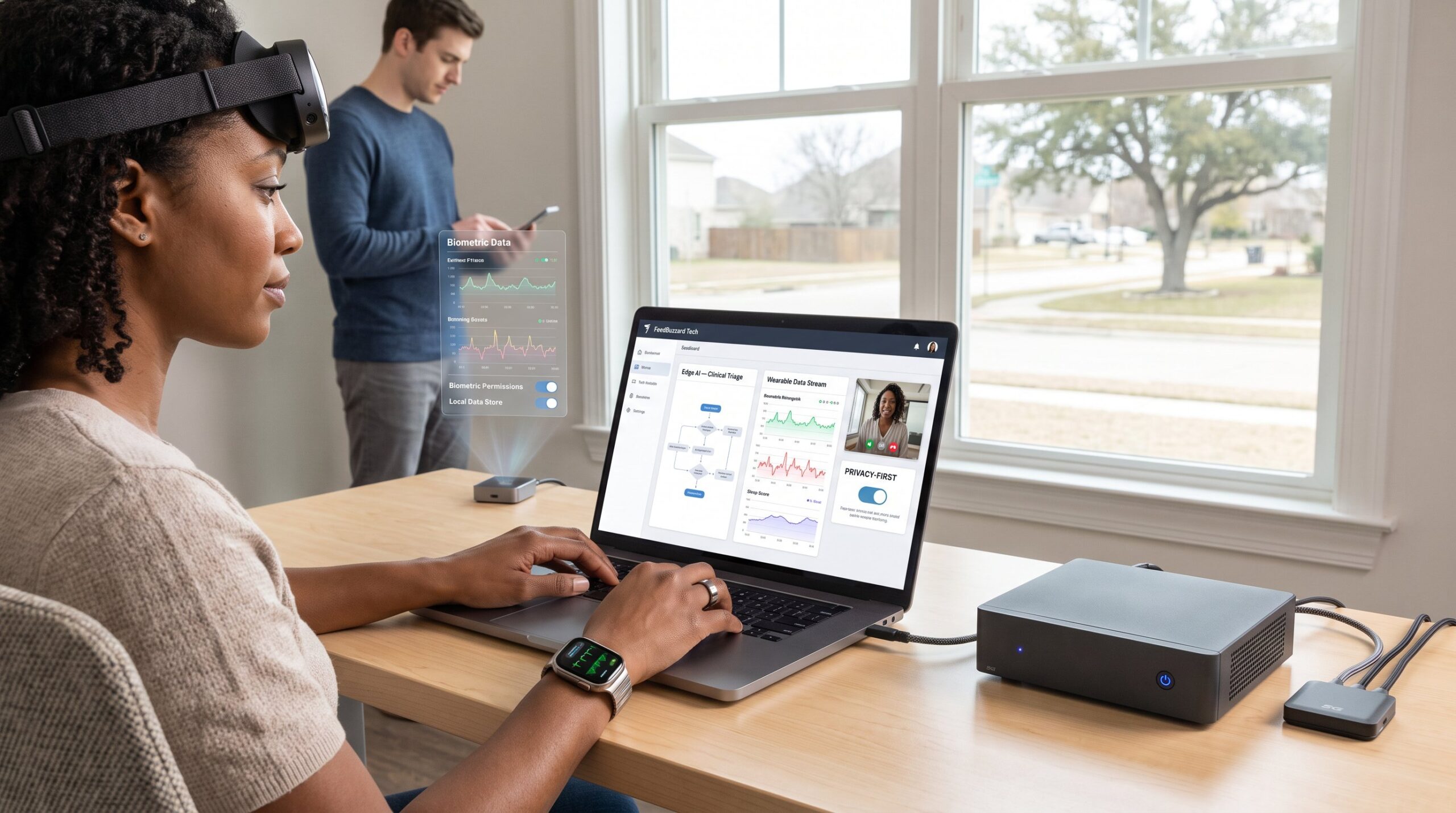
FeedBuzzard Tech: A Guide to World Technology, Wearables, and Digital Trends introduces what matters in 2026 for everyday users and professionals. It explains which advances change health, work, and privacy now, not someday, and shows how to pick devices and skills that give real returns. Readers get clear signals on AI agents, edge computing, XR, and wearable sensors so they can act with confidence instead of chasing every headline.
Key Takeaways
- FeedBuzzard Tech highlights how specialized AI agents and edge computing transform health, work, and privacy in 2026, empowering users with practical tools.
- Wearable tech in 2026 is judged by sensor accuracy, battery life, and ecosystem compatibility, guiding buyers to choose devices that offer real health and productivity benefits.
- Edge-first architecture reduces latency and protects data by processing information locally, crucial for applications like AR training and remote health monitoring.
- Continuous, actionable health data from wearables shifts care from periodic checks to prevention, emphasizing the importance of data consent and ownership.
- Market trends show booming shipments of hearables and smart devices, making ecosystem support and validated health metrics essential for selecting wearables.
- A one-month trial is recommended to verify wearable device accuracy and software maturity before committing to purchase, avoiding costly mistakes.
What FeedBuzzard Tech Covers And Why It Matters To You
FeedBuzzard Tech covers four clear areas that shape decisions people make today: AI in real-world services, faster and private networking at the edge, extended-reality interfaces, and practical wearable sensors. Those focus areas affect job roles, daily health choices, and the control people keep over their data.
AI in context. The site highlights AI models tuned for specific fields, medicine, climate forecasting, legal analysis, and how those models change outcomes. For example, a clinic using a vertical AI agent can reduce triage time by measurable amounts and flag anomalies faster, which changes how staff prioritize care. For deeper guidance on evaluating AI tools and reviews, FeedBuzzard Tech links to a practical checklist that helps readers compare model claims and verification data: evaluation checklist.
Why networks and edge matter. FeedBuzzard Tech shows how edge computing and 5G/6G lower lag and keep sensitive data local. That matters when an augmented-reality training session or a surgical-assist device cannot tolerate even tens of milliseconds of delay.
Wearables and lived experience. The site treats wearables as measurement platforms, not fashion accessories. It contrasts wrist devices with smart rings and hearables, and explains the trade-offs between sensor accuracy and battery life. Readers who want a broad primer on devices can explore a hands-on overview of wearable devices: wearable primer.
Concrete stakes. FeedBuzzard Tech connects trends to numbers: expected shipment volumes, revenue trajectories, and adoption rates. That helps a buyer choose a device that saves explicit time (for example, automatic sleep scoring that removes 30 minutes per week of manual tracking) or an employer decide whether to trial body-worn sensors in a pilot.
Major World Technology Trends To Watch In 2026
Edge AI and vertical agents lead the list. The clear fact: specialized AI agents will move from research demos into regulated domains such as law, finance, and clinical decision support. These vertical agents reduce repetitive review work and speed expert workflows: firms experimenting with them report measurable cuts in review time and fewer missed cases.
Spatial computing and XR are shifting from novelty to utility. In 2026, companies use spatial interfaces for safety training and remote collaboration. The Verge preview of CES 2026 highlighted how XR demonstrations are now built around repeatable workflows rather than splashy demos, which signals maturity in the market: CES 2026 preview.
Edge-first architectures cut cloud dependence. The insight: running models locally reduces latency and avoids shipping raw personal data to cloud servers. That change helps devices that must operate when connectivity drops, industrial sensors, remote health monitors, and AR headsets. FeedBuzzard’s coverage on upcoming wearable trends outlines how manufacturers balance on-device ML with cloud analytics for battery and privacy trade-offs: wearable trends 2026.
Health data becomes continuous and actionable. Wearables now stream near-real-time biometrics into care pathways. That moves monitoring from periodic check-ins to continuous prevention. FeedBuzzard Tech examines how hospitals and startups connect these streams to clinical records, and it flags governance questions readers must ask about consent and data ownership.
Green tech and biotech gain attention. Advanced climate models run on specialized hardware and biotech firms use modeling to speed drug discovery. The key takeaway for readers: sitting on the sidelines risks losing skill relevance: learning to interpret data and to manage privacy will be a workplace advantage.
Wearable Tech Essentials: Devices, Use Cases, And Buying Tips
The essential fact: in 2026 wearables are evaluated on three primary axes, sensor accuracy, battery life, and ecosystem compatibility. Buyers who rank these axes by personal need make better choices and avoid buyer’s remorse.
Devices and clear use cases. Smartwatches remain the jack-of-all-trades: notifications, ECG, activity tracking. Smart rings and hearables excel where comfort and discreet sensing matter. FeedBuzzard’s hands-on device coverage explains which form factor suits specific needs and how companies position products: readers can compare companies and gadgets in a concise profile set: company profiles.
Concrete market signals. Market forecasts show large volumes: hearable shipments alone are predicted to reach roughly 407.6 million units in 2026. Those numbers matter because scale drives accessory ecosystems, third-party apps, and lower prices. For people focused on health metrics, choosing devices that support ECG and validated sleep analysis is non-negotiable.
Buying checklist with measurable criteria. Prioritize these features in order:
- Sensor validation: prefer devices with peer-reviewed accuracy claims or regulatory clearance.
- Battery targets: at least 3 days of mixed use for daily wearables: longer for rings.
- Integration: confirm the device exports raw or summarized data to platforms the buyer trusts.
Practical warning. Many devices market AI features broadly but deliver limited clinical value. To avoid wasted spending, buyers should consult empirical device comparisons and data-flow policies before purchase. FeedBuzzard Tech links real product reviews to explain the trade-offs between comfort and measurement fidelity, and it explains how wearable data is reshaping apps for fitness and health analytics: wearable data changes.
A vulnerable note. Early adopters often buy the newest model and later discover the software ecosystem lags. FeedBuzzard recommends a one-month trial window: if the device does not show consistent, accurate readings in 30 days, it likely won’t provide long-term value.
Conclusion
FeedBuzzard Tech shows that AI, edge computing, XR, and wearables form a practical toolkit for 2026 life. The high-value moves are simple: choose devices with verified sensors, learn to assess AI tool claims, and treat data ownership as a primary purchase criterion. Readers who act on these specifics gain measurable advantages in health and productivity rather than chasing every new release.