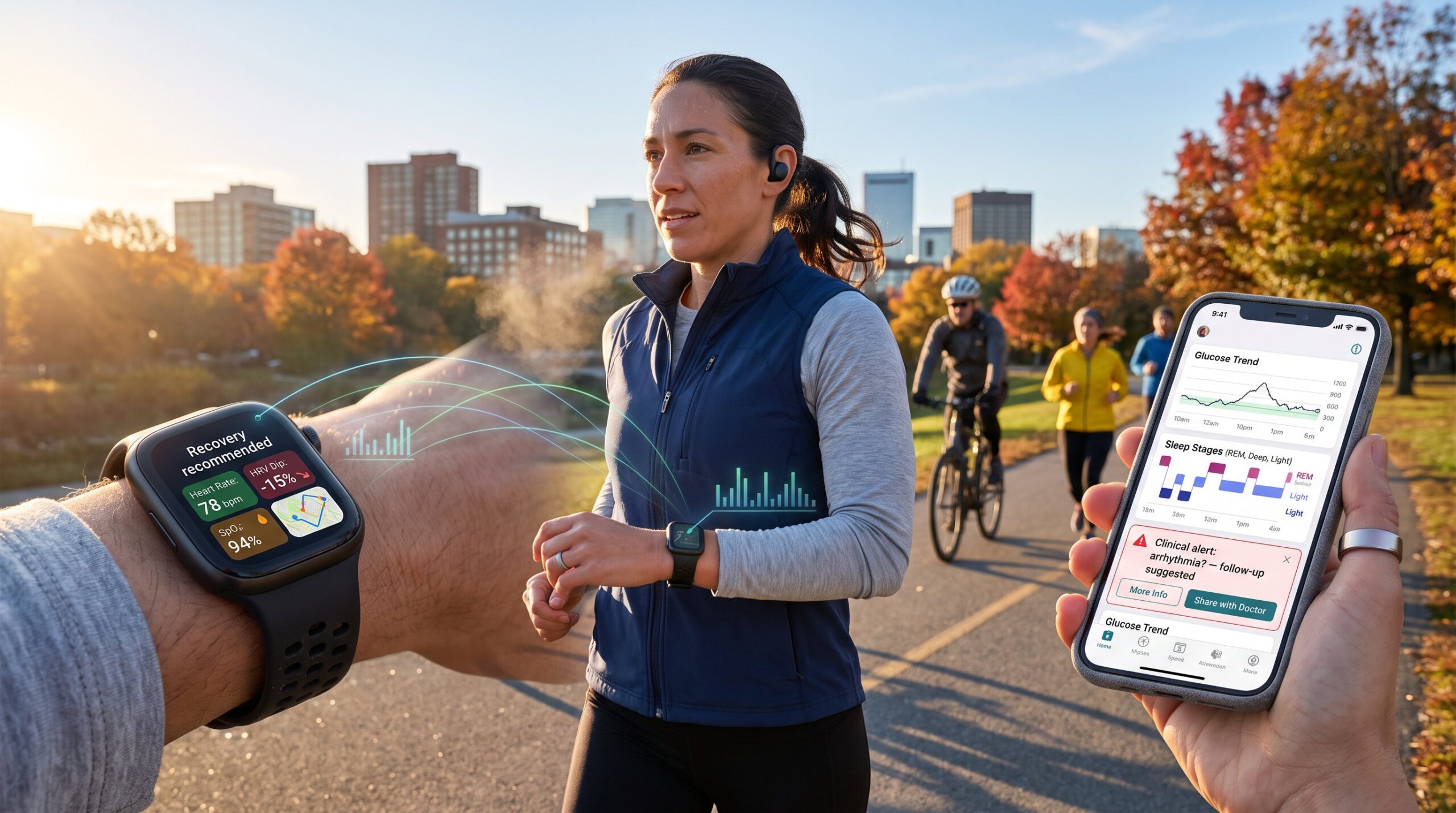
How wearable data is changing fitness and health apps becomes obvious the moment someone glances at their watch after a morning run. The watch records heart rate, pace, sleep, and even skin temperature, then feeds those signals into apps that adapt workouts and flag health risks. This article explains what wearable data includes, how apps turn it into personalization and clinical insight, and the practical problems developers and users must solve. It aims to give clear, actionable information for readers who want to understand the current landscape and make better choices about devices and apps.
Key Takeaways
- Wearable data powers fitness and health apps by continuously capturing physiological and behavioral metrics that enable personalized workout plans and real-time coaching.
- Smart fitness apps use wearable data such as heart rate variability and oxygen levels to adapt training intensity, reducing injury risk and improving recovery.
- Clinical insights from wearables support remote patient monitoring by detecting arrhythmias or glucose irregularities, advancing chronic disease management.
- Privacy, accuracy, and interoperability are critical challenges; users should choose devices with validated sensors and transparent privacy controls, while developers must ensure data security and standardization.
- Apps that integrate wearable data effectively provide smarter, adaptive fitness experiences and meaningful health insights, shifting the industry toward personalized care.
What Wearable Data Includes And How It’s Collected
Fact: Wearable devices capture physiological, behavioral, and contextual data continuously or near-continuously.
Wearables today include smartwatches, fitness bands, smart rings, continuous glucose monitors (CGMs), and disposable ECG patches. Each device uses one or more sensor types: optical photoplethysmography (PPG) for heart rate and SpO₂, electrical sensors for ECG and bioimpedance, accelerometers and gyroscopes for motion, chemical sensors for glucose, and temperature sensors for skin or ambient readings. A smartwatch might log heart rate, HRV (heart rate variability), steps, activity type, GPS route, sleep stages, and skin temperature every few seconds: a CGM measures interstitial glucose every 5–15 minutes.
How data moves: sensors stream readings to a companion smartphone app or gateway, which buffers and uploads compressed data to cloud platforms. That flow enables long-term trend analysis and model training. Manufacturers often preprocess signals locally to remove motion artefacts before transmission. Practical detail: sensor placement changes accuracy, a wrist PPG during heavy arm movement will show more noise than a chest ECG during rest. Users and developers should expect variability: placement, firmware, and sampling rate all affect the final metric.
Concrete example: a runner’s device might report a 6% dip in SpO₂ and a 12 bpm rise in resting heart rate across two nights, signals that apps use to recommend recovery. For a quick primer on device types and trends, readers can review an overview of wearable technology devices. Another useful piece on sensor design appears in the site’s guide to wearable sensors.
How Wearable Data Powers Personalization, Coaching, And Clinical Insights
Answer: Apps convert streams of wearable signals into tailored recommendations, real-time coaching cues, and sometimes clinical alerts.
Personalization: Algorithms use baseline patterns, typical resting heart rate, HRV range, sleep regularity, to craft adaptive workout plans and recovery suggestions. For example, an app that tracks training load and HRV can reduce intensity when the user’s HRV drops by 15% versus baseline, sparing the runner an overuse injury. Concrete benefit: athletes following adaptive plans recorded by some apps can reduce training-related soreness incidents by measurable amounts: teams report fewer missed sessions, though exact numbers depend on cohort size and sport. For product-level comparisons, feedbuzzard hosts evaluations on top wearable health devices that show which hardware streams the richest data for personalization.
Coaching: Real-time feedback uses rules and lightweight models. When heart rate enters a target zone, the app vibrates and shows pace cues: when respiration irregularity spikes, the app suggests a breathing exercise. This real-time loop helps users correct effort or cadence immediately, a cadence correction can improve running economy by a few percentage points for many runners. Long-term coaching aggregates trends into monthly plans that shift focus from volume to recovery. The site’s analysis of the benefits of wearable technology highlights concrete lifestyle changes users achieve with consistent feedback.
Clinical insights: Remote patient monitoring platforms ingest ECG traces, glucose trends, and activity patterns to flag arrhythmias, hypoglycemia risk, or early deterioration. For instance, intermittent single-lead ECG spikes trigger a notification to seek follow-up: a CGM trend showing repeated nocturnal hypoglycemia prompts medication review. Integrations with health systems remain limited, but pilots show promise for chronic disease management. For product and company context, see the site’s piece on wearable technology companies that describes vendor approaches to clinical use.
Privacy, Accuracy, And Interoperability: The Key Challenges For Apps
Key insight: the power of wearable data depends on trust, measurement quality, and the ability to move data between systems.
Privacy and security: Wearables collect sensitive health and location data that, if exposed, can cause real harm. Users face risks from breaches and from opaque third-party sharing. Practical warning: default app permissions often enable broad telemetry: users should audit permissions and enable device-level encryption where available. On the developer side, strong consent flows, end-to-end encryption, and clear retention policies reduce risk. For readers wanting a broader technology context, FeedBuzzard’s overview of FeedBuzzard Tech trends explains governance and privacy patterns across wearable ecosystems.
Accuracy and reliability: Sensors have known failure modes. Motion artefacts, loose contact, and low sampling rates introduce error. Example: wrist PPG heart rate can be off by 10–20 bpm during heavy lifting: some optical SpO₂ estimates lose fidelity outdoors in bright light. Clinical-grade decisions require validation against reference devices, and many consumer wearables don’t meet those standards. Developers must publish validation studies or clearly label clinical limitations.
Interoperability and data silos: Proprietary formats and vendor lock-in prevent large-scale analytics and smooth EHR integration. Hospitals and researchers struggle to ingest data because timestamps, units, and event labels vary. Standardization efforts (FHIR profiles for wearables, open SDKs) help, but adoption is uneven. Concrete solution steps: apps should export normalized CSV or FHIR bundles and provide clear mapping documentation.
External verification: recent platform updates show vendors moving toward richer health summaries: for instance, Apple’s Health app changes illustrate how readiness scores and composite metrics become sharable signals that apps can use for care decisions (TechCrunch coverage).
Practical trade-offs: a startup that prioritized rapid feature rollout learned the hard way that skipping validation led to user distrust after a false arrhythmia alert, the team then paused features, ran clinical validation with 1,200 users, and rebuilt the consent UI. That vulnerable moment reduced churn but cost time and money: it’s a realistic blueprint for others.
Conclusion
Wearable data is already shifting fitness and health apps from one-size-fits-all to continuous, personalized, and sometimes clinical workflows. The technology delivers clear benefits, smarter workouts, immediate coaching, and remote monitoring, but those gains hinge on solving privacy, accuracy, and interoperability problems. Readers who choose devices should prioritize validated sensors, transparent privacy settings, and vendors that support open exports. Developers should invest in consent, clinical validation, and FHIR-compatible exports to unlock full clinical value while protecting users.