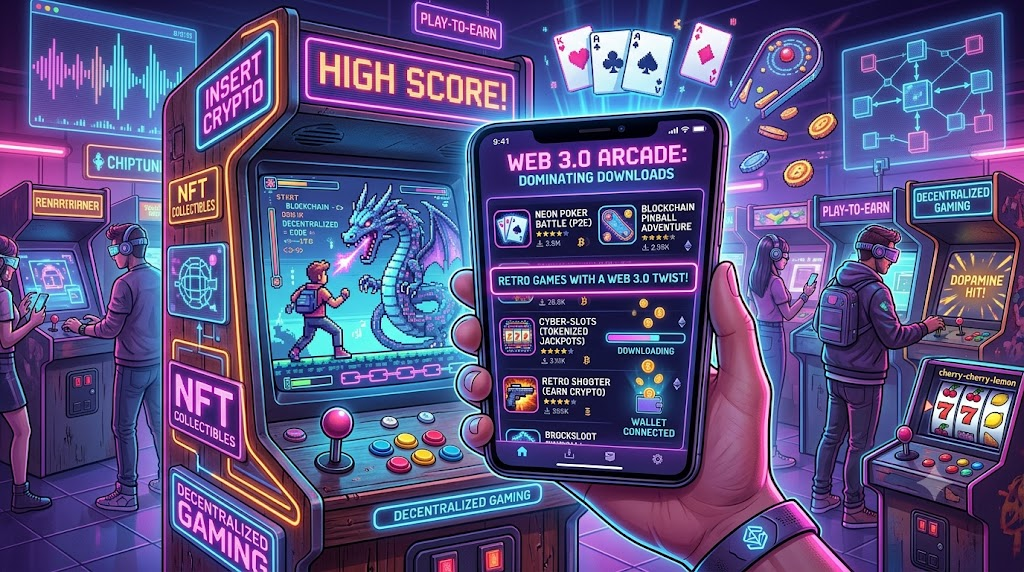
The Pixelated Trojan Horse
The contemporary digital storefront is suffering from a massive identity crisis. You have multinational conglomerates pouring billion-dollar budgets into spatial computing and volumetric rendering, yet millions of users are actively ignoring them to play 8-bit card games. Let’s be real. This sudden influx of retro arcade aesthetics across global app platforms is not an accident of nostalgia; it is a highly calculated financial maneuver. Data from late 2025 paints a brutal picture for developers across the board. The traditional growth model is effectively dead. Mobile game downloads plummeted by 12% to 24 billion in the first half of 2026—all while the cost of digital advertising to acquire new users surged to a staggering $7 billion and mid-core gaming revenue cratered simultaneously. Studios can no longer afford to buy players through aggressive ad spends. They have to retain them entirely through frictionless, immediate design. Classic table-top mechanics—like a 52-card deck, a pinball flipper, or a digital slot reel—solve this retention crisis instantly. Players intuitively understand these rulesets, which allows developers to bypass exhausting, expensive tutorial phases and inject users directly into a core interaction loop.
The ‘Balatro’ Blueprint: Exponential Math in a $2 Suit
Look closer at the 2024 indie juggernaut Balatro, and the true nature of this strategy reveals itself. A solo developer built a poker-themed roguelike deck-builder entirely on the Love2D engine using Lua architecture. It immediately demolished industry titans like Minecraft and established massive franchises on the iOS charts. If this were just a standard poker simulator, it would have failed completely. The genius of Balatro lies in how it subverts a universally recognized retro base with brutal, exponential mathematical scaling. You start a run with a standard hand of playing cards. A few rounds later, you are purchasing digital modifiers known as “Jokers” that fundamentally rewrite the simulation’s math. One card might grant thirty extra chips for every odd number played; another multiplies your score sequentially until a face card breaks the chain. Combine these with consumable Tarot cards that clone your high-value assets, and a basic pair of eights rapidly evolves into a multi-billion-point combo. This exposes a brutal industry reality. Modern consumers do not actually want simple games. They crave insanely complex, high-stakes mathematical environments hidden behind the safe, digestible interface of a parlor game.
Hijacking Dopamine and the Mechanics of ‘Dark Flow’
This massive engagement stems from a rigorous application of behavioral economics. The entire architecture of the modern arcade revival relies on operant conditioning, specifically the deployment of variable ratio reinforcement schedules. Brain chemistry does not work the way most people assume. Dopamine only floods your system when a reward prediction error occurs. A digital crate dropping some absurdly rare item out of nowhere forces the prefrontal cortex into overdrive. That exact moment cements a compulsive habit forever. Unpredictable cadences like this frequently induce “dark flow”—a hypnotic psychological state where intense focus marries repetitive, chance-based loops to shut out external cognitive loads entirely. Frankly, the software is hacking cognitive biases. The most potent tool in this arsenal is the near-miss effect. Picture a standard digital slot reel stopping one millimeter away from a massive jackpot. The math says you lost every single cent of that bet. Your brain, however, completely ignores math. Human middle-cerebral areas read that visual tease as a massive, exhilarating near-victory. Clinical studies show that a deliberate near-miss rate of 30% optimally captures user attention, creating a false illusion of control over a randomized backend algorithm. Developers then amplify this cognitive hijack through advanced psychoacoustics. Modern titles utilize up to 400 layered sound effects to deploy Losses Disguised as Wins (LDWs). A player wagers two dollars and wins back thirty cents. Despite the definitive net loss of a dollar seventy, the software erupts in celebratory chimes and rhythmic bells. Auditory barrages like this successfully short-circuit rational mathematical tracking, replacing logical assessment with an overwhelming physical perception of continuous victory.
Blurring the Sandbox and the Casino Floor
The financial mechanics pioneered by mobile gaming have inevitably leaked into regulated betting ecosystems. Boundaries separating traditional video games, app store monetization, and digital gambling have effectively collapsed. Take a critical look at platforms like DraftKings. They do not just offer green-felt table simulators anymore; they curate interactive environments that perfectly mirror the hybrid-casual gaming sector. Crash games force players to watch a multiplier curve escalate, demanding they manually cash out before a randomized algorithmic crash destroys their initial wager. This exact loop requires zero tutorials while hyper-activating the user’s illusion of control over the outcome. There is an undeniable utility in the straightforward mechanics of these retro-inspired games for maximizing lifetime user value. This architecture taps directly into the exact same psychological reward systems that make an online casino real money application highly addictive, transforming casual digital interactions into highly monetizable behavioral loops. We see hybrid formats like Slingo—a rapid-fire mashup of slots and bingo—invoking retro intellectual property directly alongside Live Dealer leaderboards. Bidirectional convergence means that free-to-play mobile apps mimic the thrill of gambling through virtual currencies, while regulated betting platforms adopt arcade UI to maximize daily active users.
Cryptographic Truth in a Trustless Ecosystem
Unsurprisingly, this aggressive optimization of human compulsion has triggered severe global regulatory blowback. The $15 billion loot box industry sits precisely in the crosshairs of consumer protection agencies. Global regulators routinely equate these randomized virtual drops with mechanical slot machines, prompting absolute bans in Belgium and heavy scrutiny across the United States and Europe. The core friction point is a total collapse of consumer trust. When you interact with a proprietary random number generator on a centralized server, you are entirely at the mercy of a corporate black box. You cannot verify if the odds were dynamically throttled against you to maximize a quarterly revenue target. Web 3.0 infrastructure is aggressively stepping in to solve this exact deficit. Through the deployment of blockchain technology and smart contracts, the digital entertainment sector is shifting toward a “provably fair” paradigm. The exact mathematical payout tables and drop rates get hardcoded into an immutable public ledger. To stop internal tampering, studios rely on Verifiable Random Functions—specifically VRFs pushed through decentralized oracle networks like Chainlink. The system forces a secure private key to spit out a random value paired with an undeniable cryptographic proof. The smart contract refuses to execute anything until it validates that specific proof. This guarantees the outcome was completely unpredictable beforehand and entirely tamper-proof afterward. The catch? This transparent architecture exposes the ecosystem to vulnerabilities like Oracle manipulation and Maximal Extractable Value (MEV) exploits. Strategic trajectories are already locked in, however. The next iteration of digital entertainment will not be defined by who renders the best graphics or licenses the biggest IP. The dominant players will be those who can seamlessly wrap highly sophisticated, cryptographically verifiable algorithms inside the comforting, pixelated shell of a 1980s arcade cabinet.