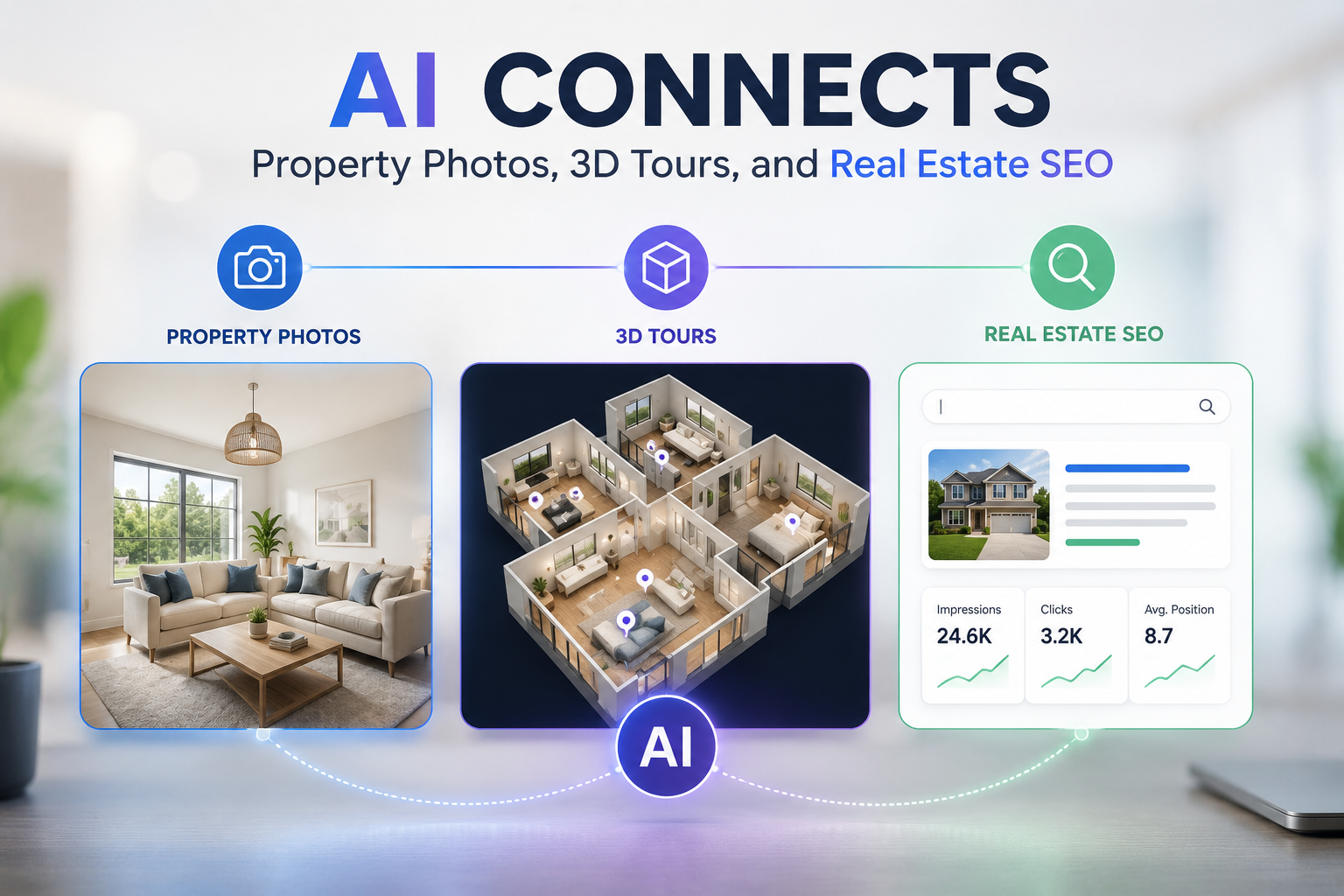
Online property marketing now works like three gears in one machine: visual quality, spatial experience, and search visibility. A home competes through price, location, and size, but online visibility also depends on listing photos, digital tours, and real estate SEO.
AI has entered all three layers at once. It edits images, stages empty rooms, reads room data from tours, and helps teams write property pages that buyers and search systems understand. Under the hood, the listing workflow has become faster, more connected, and more measurable.
Why Property Photos Are the First Real Estate SEO Signal
A property image often creates the first yes or no moment. Before a buyer reads the description or opens a tour, the photo sets expectations. If the image looks dark, cluttered, or unclear, many people move on. If the image looks clean and useful, the listing has a stronger chance of earning a click.
That makes photos part of real estate SEO, not just part of design. Search visibility depends on more than words on a page. It also depends on how people react to the result they see. Strong photos usually lead to more clicks, more gallery views, and longer visits. Those actions tell listing platforms and search systems that the page gives users something worth reading.
The link is not mechanical. A better image does not guarantee a better rank. Still, the pattern makes sense. Search tools try to send people toward useful pages, and useful pages to keep people interested. On property pages, it’s the photo gallery that often creates the first sign of interest.
What AI Does to Listing Photos and Virtual Staging
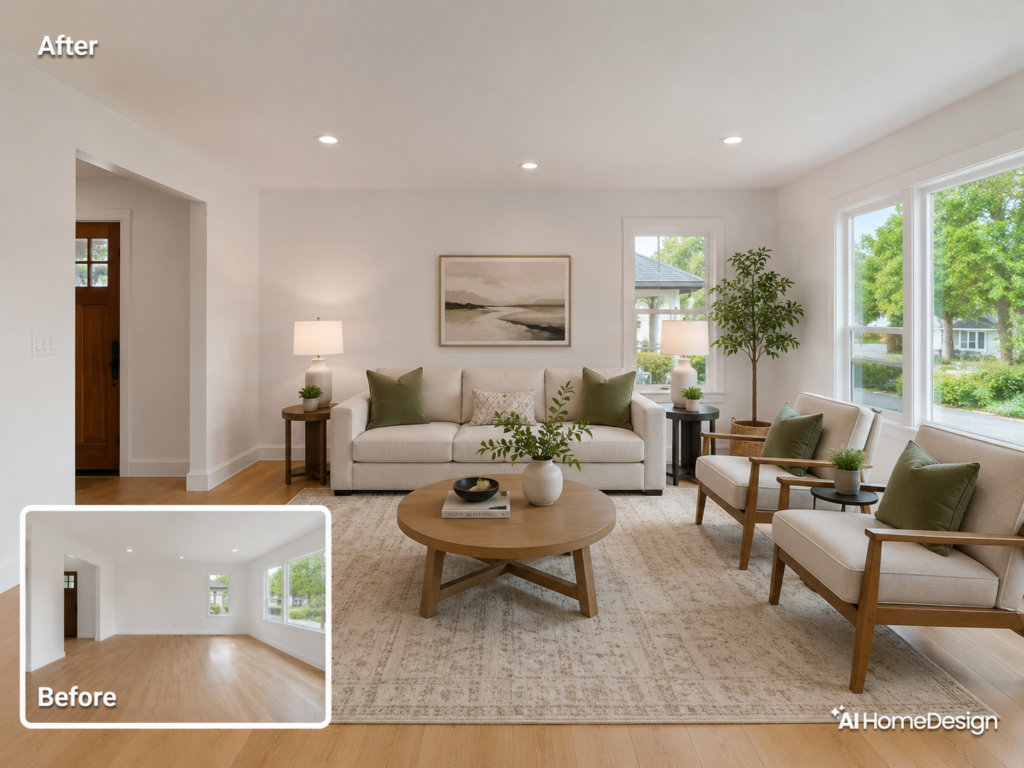
The visual layer gives the clearest view of AI real estate tools in action. Earlier workflows relied on a photographer, an editor, a staging company, and several rounds of manual work. Now, real estate photo editing tools handle many of those tasks through software.
Common edits include light correction, color balance, sky replacement, item removal, and day to dusk exterior edits. These changes help a property photo look closer to what a professional listing team would publish.
Virtual staging works on the same principle. Empty rooms often look smaller online because buyers lack furniture for scale. Tools like AI HomeDesign virtual staging enable real estate teams to upload a photo of an empty room and create a furnished version that shows the room as a living area, bedroom, or office. That kind of example helps a viewer read the room faster.
This is also where photos connect back to search. Better images invite longer viewing, and longer viewing gives the rest of the page more time to do its job. That’s how real estate photo editing has become one of the practical bridges between presentation and real estate SEO.
Where 3D Tours Fit Into the Stack
A 3D virtual tour gives the viewer a room by room version of the property. Instead of seeing separate images, the buyer moves through the home on screen and studies layout, flow, and scale.
AI now plays a role in this layer as well. Some tour systems scan data and turn it into floor plans, room labels, or rough measurements. Others improve image clarity inside the tour or help identify rooms without manual tagging. The tour becomes more than a visual add on. It becomes a source of spatial information.
That matters because time spent inside a tour often shows deeper interest than a quick glance at one photo. A viewer who opens the tour, studies the layout, and returns to the gallery has given the page more meaningful interaction. That activity supports the wider search picture because search and listing platforms tend to value useful, engaging pages.
Listing photos make the first impression, but they cannot answer every question. A 3D tour adds the missing context by showing how rooms connect, how the layout flows, and how the property feels as a whole.
How Real Estate SEO Actually Works in 2026
People often reduce real estate SEO to keywords, but search visibility depends on the full listing page. Property descriptions, neighborhood terms, image alt text, page speed, local context, and visitor behavior each play a role. A page has to explain the property clearly, load well, and give people enough reason to keep reading.
AI tools support that work in practical ways. Writing tools turn property facts into readable descriptions, image editing tools help enhance and label photos correctly, and research tools surface the local phrases buyers use when looking in a specific area. In this layer, AI real estate tools help prepare the listing for both human readers and search systems.
The stronger version starts with useful content. Weak photos, vague copy, and no spatial context leave little for buyers to study. Clear photos, a usable 3D tour, and accurate copy give the page more substance.
What Changes When the Three Layers Work Together
The larger shift is coordination. Photo tools improve the first look, tours explain the layout, written content gives search engines a clear reading of the property and its location, and real estate SEO becomes part of the listing production process rather than a task added after publication.
That changes the workflow. Teams no longer treat media, tours, and copy as separate jobs passed from one vendor to another. These now form a listing package where each layer has a specific role: photos earn attention, tours hold interest, and search content helps the right audience find the page.