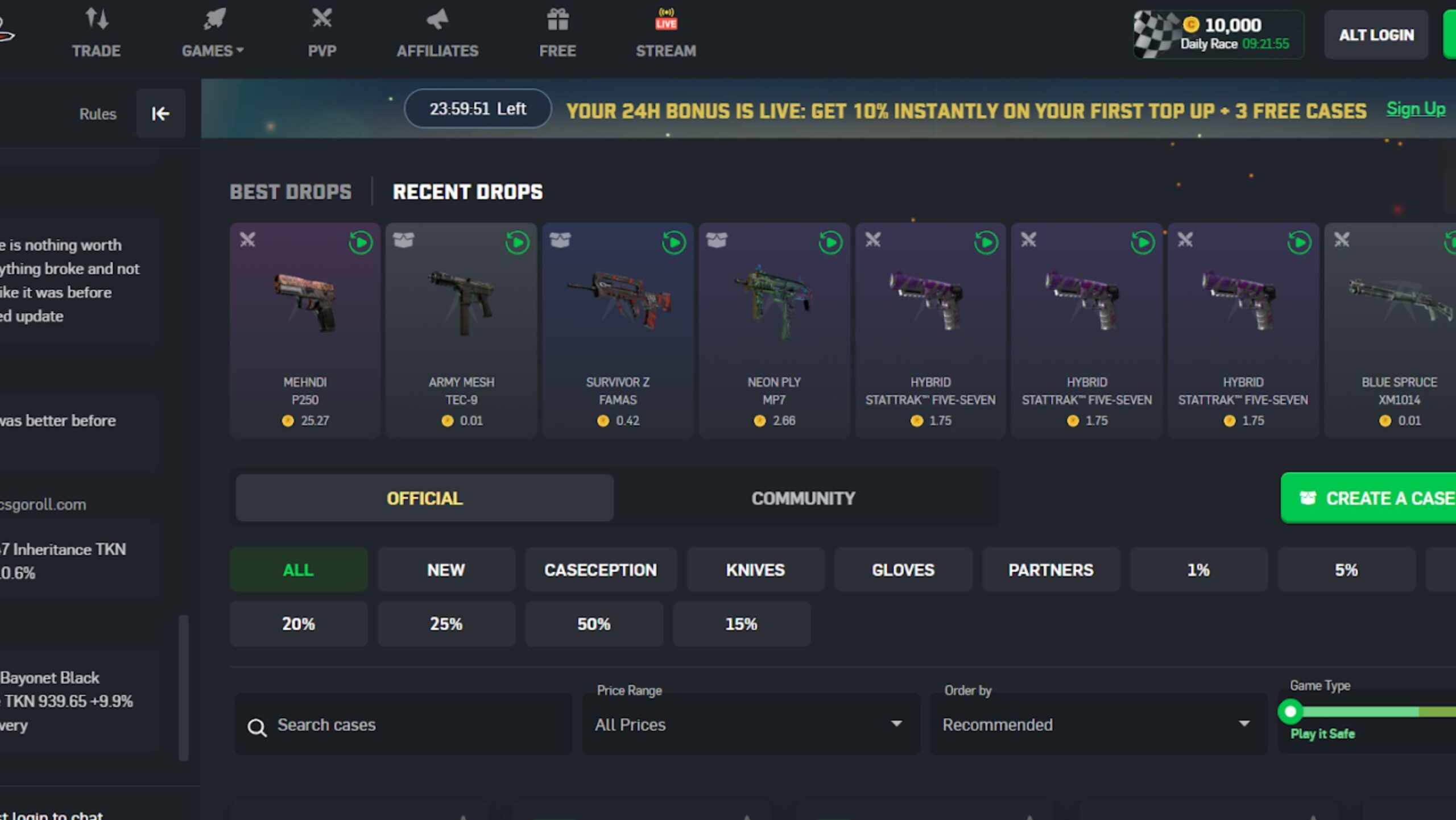
At first glance, CSGORoll promo codes don’t look like a big deal. You type in a CSGORoll promocode, get a bit of extra balance or some rakeback, and move on. Most players treat them like a small bonus and nothing more. But if you’ve been around the CS:GO skin scene for a while, you know those codes didn’t just appear out of nowhere, and they definitely didn’t stay a small detail for long.
They’re tied to how skin gambling sites grew, how creators started making real money from their audiences, and how competition between platforms slowly turned into a full-on marketing race. What started as a simple way to track referrals ended up reshaping how these sites attract players and how gambling content shows up across YouTube, Twitch, and social media.
Looking at the history of CSGORoll promo codes is really a way to look at how the whole skin economy matured. You can see the shift from messy, improvised experiments to a much more organized, data-driven business. And once you start pulling on that thread, it becomes pretty clear that this story is about a lot more than just getting a bonus when you sign up.
Where CSGORoll Promo Codes Came From
CSGORoll promo codes are a product of the CS:GO skin economy rather than a generic marketing trick copied from traditional online casinos. When skins became tradeable and convertible into real money, they stopped being simple cosmetic items and turned into a form of digital currency. This change created an entirely new type of gambling ecosystem, one built on third-party platforms that were not part of Steam itself but depended on its item infrastructure.
In the early years, most skin gambling sites looked similar and offered similar games. The market was fragmented, unstable, and extremely competitive. Users could move their inventory from one platform to another with little friction, which made loyalty weak and acquisition costs high. Sites needed a way to both attract new players and understand where those players were coming from. Promo codes solved both problems at once by combining a small financial incentive with a tracking mechanism.
Over time, these codes stopped being a minor extra and became part of the core growth strategy for many platforms. Instead of relying on banner ads or forum posts, sites began to build their user acquisition around creators, streamers, and community figures. CSGORoll entered this environment with a more structured approach, treating promo codes as a standardized onboarding tool rather than a temporary promotion. This is why codes on the platform feel less like one-off giveaways and more like a permanent part of the product experience.
From Early Skin Gambling Sites to Influencer-Driven Codes
To understand why promo codes became such a central feature on CSGORoll, you have to look at how the CS:GO skin economy evolved in the first place. When Valve introduced tradable skins, they were designed as cosmetic items, but the Steam Marketplace and third-party trading sites quickly turned them into a liquid asset class. Skins could be bought, sold, and exchanged for real money, which made them functionally similar to digital chips in an online casino.
The first generation of skin gambling sites emerged in an environment with very low entry barriers. New platforms appeared constantly, many of them offering nearly identical games: roulette, coin flips, simple jackpots. For users, switching from one site to another took minutes. Accounts were easy to create, balances were easy to move, and there was little reason to stay loyal to any single platform unless it offered a clear advantage.
This is where early referral systems and primitive promo codes came in. At the beginning, they were mostly tracking tools. A site needed to know whether users came from a forum post, a YouTube video, or a specific partner. The “bonus” attached to the active promo code was often small and sometimes symbolic, but it gave users a reason to enter the code and gave the platform a way to attribute traffic.

As the market matured and competition intensified, this system became more aggressive and more professional. Influencers on YouTube, Twitch, and later TikTok turned into the main distribution channel for these codes. Instead of generic referral links, creators promoted personalized codes tied to their brand. In exchange, they received a share of the revenue generated by the users who signed up through them.
CSGORoll entered the scene when this model was already proven but still unevenly implemented. Rather than treating promo codes as a side feature, the platform built them into its growth strategy from the start. Codes were no longer just a way to track traffic; they became a standardized onboarding tool, a marketing lever, and a retention mechanism. This marked a shift from improvised growth tactics toward a more structured, performance-driven approach to user acquisition.
How CSGORoll Promo Codes Actually Work
On CSGORoll, promo codes are designed to shape user behavior over time rather than just to trigger a single deposit. The most visible incentives are deposit bonuses and rakeback, but the real function of these systems is to influence how often users return, how long they stay active, and how much they wager across multiple sessions. This turns promo codes into part of the platform’s economic engine, not just its marketing layer.
A deposit bonus reduces the perceived cost of entry. It makes the first interaction with the platform feel less risky and more flexible, which increases the likelihood that a new user will actually try different games instead of placing one cautious bet and leaving. Rakeback works in the opposite direction: it rewards volume and consistency. The benefit grows with activity, which subtly pushes users toward longer and more regular play patterns.
From the business side, this structure allows CSGORoll to forecast costs and returns with reasonable accuracy. Bonuses are not unlimited giveaways; they are calculated against expected user value. At the same time, promo codes provide precise data about which creators, communities, or campaigns bring in players who actually stay and play, rather than just sign up and disappear.
Bonuses, Rakeback, and the Business Logic Behind Them
From a user’s point of view, a CSGORoll promo code usually promises something straightforward: extra balance, a deposit match, or ongoing rewards. Behind that simple message sits a carefully balanced economic model. The platform is not trying to give away value for free; it is redistributing part of its expected revenue to shape how and how often users play.
One common component is the deposit bonus. This increases the user’s starting balance, which lowers the psychological barrier to placing the first bets. A player who deposits $50 and receives an extra $50 in bonus funds behaves differently from someone who deposits $50 with no incentive attached. The perceived risk is lower, and the willingness to experiment with games or higher bets increases.
Rakeback works on a different principle. Instead of concentrating the reward at the beginning, it returns a percentage of wagers over time. This ties the benefit directly to activity. The more a user plays, the more they receive back. From a business perspective, this encourages longer retention cycles and higher lifetime value per player. From a user’s perspective, it creates the feeling of an ongoing advantage rather than a one-time promotion.
Promo codes also serve a precise measurement function. Each code identifies a traffic source, usually a specific creator or partner. This allows CSGORoll to calculate, with reasonable accuracy, how much revenue each channel generates versus how much it costs in commissions and bonuses. Over time, this data shapes which partnerships are expanded, which offers are adjusted, and which marketing strategies are abandoned.
The result is a system where bonuses are not random or purely promotional. They are part of a feedback loop that connects user behavior, marketing spend, and platform revenue. This is one of the main reasons promo codes survived while many other early growth hacks in the skin gambling scene disappeared.
The Broader Impact on Gaming and Skin Economy Culture
The widespread use of promo codes changed how skin gambling platforms compete and how gaming content is monetized. What started as a technical referral feature evolved into a central pillar of platform growth and creator income. This shift had consequences not only for businesses, but also for players and for the public perception of the entire ecosystem.
Competition between platforms increasingly moved into the marketing layer. Instead of differentiating only through games or design, sites began to compete through better deals, higher creator payouts, and more aggressive promotional campaigns. For creators, this opened up a new and often more reliable revenue stream than traditional ad monetization. For players, it created an environment where nearly every recommendation came bundled with an incentive.
At the same time, this system introduced new trust issues. When financial incentives are embedded in recommendations, it becomes harder for users to tell whether a platform is being promoted because it is genuinely good or because it pays better. This tension, combined with the growth of the skin gambling market, attracted increasing attention from regulators and platform owners.
Marketing Arms Race, Player Trust, and Regulatory Pressure
Once promo codes proved their effectiveness, they stopped functioning as a competitive advantage and turned into an industry standard. Any platform that wanted to be taken seriously had to offer some form of code-based incentive, whether through deposit bonuses, rakeback, or creator-linked rewards. This shift changed how platforms competed. Product features and game selection still mattered, but marketing spend and distribution networks started to play a much larger role in who grew faster and who disappeared from the market.
The result was a steady escalation. Platforms increased commissions for creators to secure better placement and more frequent mentions. Bonuses became more prominent in promotional messaging and were often presented as a core reason to choose one site over another. Social platforms filled with near-identical integrations, referral links, and code mentions, which normalized the idea that gambling platforms and content creators were tightly intertwined at a commercial level. Visibility became a function of budget, relationships, and incentive structures rather than only of user experience.
For creators, this reshaped the economics of gaming content in a very practical way. Affiliate codes offered a direct link between audience size and revenue, without the volatility of ad rates or the uncertainty of brand sponsorships. Smaller creators could sustain their channels with a relatively niche but loyal audience. Larger creators began to treat gambling integrations as a stable revenue pillar rather than an occasional promotion. Over time, this pushed gambling-related content from the margins into a more regular and predictable part of gaming media output.
At the same time, this commercialization blurred important boundaries. When a creator recommends a platform and also earns from every user who signs up through their code, the recommendation is no longer neutral. For viewers, it became harder to separate genuine product opinion from financially motivated promotion. The format of the content often stayed the same, streams, videos, guides, but the incentives behind it changed, and that change was not always clearly visible to the audience.
For players, promo codes created both convenience and confusion. They made it easier to compare platforms on the surface level, because bonuses and rakeback percentages could be lined up next to each other. They also lowered the entry barrier and reduced the perceived cost of trying a new site. At the same time, they introduced more complex terms, wagering requirements, and conditional rewards that many users did not fully evaluate before signing up. A “better” bonus on paper did not always translate into better value in practice.
Several structural effects followed from this shift:
- Competition moved increasingly into marketing and affiliate networks
- Creator income became more tightly coupled to platform performance
- Platform growth became more dependent on paid distribution than on organic adoption
- User acquisition costs rose across the entire secton
- Promotional messaging became more standardized and less informative
- The gap widened between how offers were presented and how they actually worked in practice
These dynamics inevitably attracted regulatory attention. As skin gambling grew in visibility, so did concerns about underage access, the framing of gambling-like products in gaming spaces, and the lack of clear disclosure around sponsored content. In multiple regions, regulators and platform holders began to push for stricter rules around age verification, advertising language, and the transparency of creator-platform relationships.
This did not remove promo codes from the ecosystem, but it did change their role. They became more formalized, more regulated, and more tightly integrated into compliance frameworks. Platforms had to invest in clearer terms, better disclosure, and more robust user verification. Creators, in turn, faced higher expectations around labeling sponsored content and explaining their financial relationships with the services they promote.
In this broader context, CSGORoll promo codes represent more than a simple marketing mechanic. They are a visible result of the skin economy’s transition from an improvised, fast-moving gray market into a more structured, data-driven, and externally supervised industry. Their evolution reflects the same pressures that shaped the scene as a whole: rising competition, professionalized marketing, shifting creator incentives, and increasing regulatory scrutiny.